The bad blood between Ravana and Rama had been boiling for years. Ravana, constantly beaten back by Rama, was becoming agitated with his enemy's persistence and was now eager to end this struggle. However, this was not simply born from lack of interest in the conflict. No, no, no, this came from a feverish desire to avenge his sister, Shurpanakha, and revel in the peril of his foe.
Operating in secrecy , Ravana befriended a hermit named Maricha who he knew had his own previous conflicts with Rama. Sharing a common enemy, the two devised a plan to overcome the mighty Rama.
Everyone who knew Rama knew that his love for Sita was a bond unlike any other. This love provided Rama with the strength to overcome any obstacle in order to ensure the safety of his beloved Sita. This exposed a weakness, and his foes began to scheme…
Ravana: Tell me, Maricha, what is one thing that you cherish above all else in this world?
Maricha: That is simple, my lord. Nothing could ever surpass the happiness my mother brought me.
Ravana: Precisely! Only a man cruel as Rama could deprive a man of his mother's love. We must do to him what he has done to you.
Maricha: I am sorry, but I do not follow.
Ravana: Tell me, what do you know about the tale of the Trojan Horse?
Maricha: Ah! A marvelous feat of intelligence. The Greeks, accepting defeat and returning to the shores of Greece, presented a mighty horse made of wood to the people of Troy. Or so it seemed.. The Trojans, drunk with pride, accepted the offering as a gift and a sign of victory. Little did they know, amid their revelry and ignorance, hid a small legion of Greek soldiers within the mighty horse. Once the time was right, the soldiers snuck out and opened the gates to their fellow Greeks who had returned under the cover of night. Once the gates were breached, the Greeks were easily able to overcome the Trojans.
Ravana: Exactly! In order to defeat Rama we must first breach the fortified gates of his heart, to which Sita holds the key.
Mericha: I don’t like where this is going, Ravana. Though it is true I have had my mishaps with Rama in the past, I wish for no man to experience the pain I felt when I lost my mother.
Ravana: Do you dare question my mission?! The choice is simple-aid in my quest to take down Rama, or stand in the way and fall by his side.
Mericha: No, no, great Ravana, I am with you.
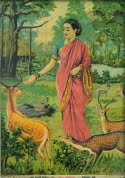
Ravana: Good. Now, you are going to be my Trojan Horse. You will take the disguise of a golden deer to distract Rama and Lakshmana. A sight marvelous as this will surely mesmerize Sita. Unable to see her desires go unfulfilled, Rama will attempt to capture the beast, leading him out into the woods. Then all we need to do is lure his brother away. This will not be a difficult task. Once Sita is alone, I will easily snatch her up. We will take what is most precious to him when he least expects it, leaving the mighty Rama broken and exposed.
Author's Note: This
story is based off the episode of Ravana and Maricha from the Public Domain Ramayana. I chose
this style of writing because it highlights the tactical deception called upon
by Ravana. Just as the Greeks did in the Trojan War, Ravana constructed a thing
of beauty to help expose his enemy. In this case, Ravana would be the Greeks
while Rama represents the Trojans. More specifically, Rama's love for Sita
represents the gates of Troy, which will leave Rama crushed once this is
breached. There is a lot of detailed dialogue that takes place between Ravana and
Maricha in these stories so I borrowed this as an easy way to explain the relationship of this story to
the Trojan Horse. I chose this topic because the deception of the Trojan Horse
is something that the majority of people are familiar with. In this way, it
becomes easier for people who are not familiar with the Ramayana to
understand the workings of Ravana and his conniving, deceitful ways. While the Greeks are usually glorified for their use of the Trojan Horse, this provides a example of how it can inspire the workings of a villain like Ravana. This was
something that caught my attention early on. Ravana used Rama’s strongest
aspect, his love for Sita, as a way to bring him down. There is a lot of irony
in the situation and I think the Trojan Horse was a good parallel to help point
that out.
Bibliography: Public Domain Edition of Ramanaya
Myths of the Hindu Buddhists by Sister Nivedita (1914)
Ravana and Maricha


