Showing posts with label Portfolio. Show all posts

Wednesday, November 18, 2015

Week 13 Storytelling: The Red Paperclip

The story begins in Belcarra, Canada, a small town outside of Vancouver. It is here, in a place that most have probably never even heard of, where Kyle McDonald called home. Now, some of you may already be familiar with this name. I know what you might be thinking, but no, Kyle has nothing to do with infamous “Golden Arches”. Actually, his story is much more interesting than extra salty fries and apple pies.

Since of the days of his youth, Kyle was always a person who had some project he was working on. Whether that was building a Lego castle, setting up a lemonade stand, or starting up his very own lawn mowing company-Kyle was always busy with something. There was something about the excitement of watching something grow and develop right in front of your eyes that turned these projects into a sort of obsession. However, although he didn’t know it, this obsession would pay off for him, in a big, big way.

It started off as a joke, really. You see, Kyle had never really liked the color red, nor did he like paperclips- they reminded him too much of school. One day, surprisingly enough, he was working on a project at home when he noticed a red paperclip sitting on his desk. His first impulse was to simply throw it in the trash bin. However, sticking true to his colors, he thought to himself “You know what? Let’s have some fun with this”.

So, Kyle took a picture of the red paperclip and posted it to the barter section of the Craigslist site in hopes that he would be able to trade it for something bigger or better. As luck would have it, a few days later Kyle was the proud new owner of a fish-shaped pen!

“That was so easy..” Kyle thought to himself, so he decided to keep on trading, always on the lookout for the “bigger and better”. Later that day, Kyle wound up trading the beloved fish pen for a hand sculpted door-knob. “Let the games begin..” Kyle thought to himself, inspired by the initial success of his latest project.

Only a handful of trades later, Kyle had wound up with a fully operational snowmobile. His friends and family could not help but laugh at how well the whole thing was going.

The snowmobile turned into a prepaid vacation, which eventually turned into a role in a real life movie..seriously, you can’t make this stuff up..

All said and done, after a series of 14 trades, Kyle had gone from owning an annoying red paperclip to inheriting a 2-story house.

Now, Kyle’s story was a big hit and all of his neighbors were eager to meet him. Coincidently, Kyle ended up falling for one of his new neighbors, to which he is now married. To this day, the couple lives “happily ever after” in their picturesque red paperclip home.

File:One red paperclip.jpg
One Red Paperclip: Wiki Commons 


Author’s Note. This story is based on “The Little Gildmaster” from Francis and Thomas’ Jataka Tales. This was the first story in the reading, but I even after reading all of the other stories, it still was my favorite of the series. The story is about a young man who hears a guildmaster say that anyone who picks up a certain dead mouse in the road will become rich and enter into a happy marriage. Overhearing this, a common-folk man picks up the mouse and begins a series of trades and schemes that eventually make him wealthy. Ironically, the gildmaster who started the whole thing wound up offering his daughter’s hand in marriage to the newly rich man. I had heard this story about the paper clip before and thought it would make a good parallel. I like both of these stories because it shows how funny the world can work sometimes, but more importantly how you can create a lot out of a little with the right plan and perseverance. My story is pretty close to the actual events that took place with the red paperclip, but I did add the marriage to his neighbor as a way to make it follow the course of the original story more closely.

Bibliography. 
Title: Jataka Tales
Author: H.T. Francis and E. J. Thomas
Year: 1916


Thursday, November 12, 2015

Portfolio Guide


This story is based on the tale of the Golden Deer of the Ramayana. It tells the tale of how Ravana was able to kidnap Sita. 

Giovanni Domenico Tipeolo, Procession of the Trojan Horse in Troy. 1773..jpg
The Trojan Horse: Wiki Commons


Trouble in Middle Earth 

This story adapts the tale of Rama's exile to fit the famous trilogy, The Lord of the Rings. It demonstrates how good men can be tainted by their jealous, bitter peers.
Representation of Dasaratha being asked in court to banish R Wellcome V0045070.jpg
King Dasaratha is asked in Court to Banish Rama: Wiki Commons 


Mahabharata Draft Day 

A modern twist on the on the Mahabharata as the Pandavas and Kausavas prepare for battle.
File:First Take Salute the Troops broadcast.jpg
Skip Bayles on ESPN's First Take: Wiki Commons 


Hear No Evil, See No Evil,  Speak No Evil

Try as he might, young Buddha's father cannot prevent the life the Gods have destined for his son.

File:NikkoNoEvil4902.jpg
The Three Monkey's at Toshogy Nikko : Wiki Commons

Paradise Lost

A noble Shoshone Chief demonstrates the difference between a leader and a ruler.

Snake River with Teton Range: Wiki Commons 

The Red Paperclip 

The story of how one man turned a single red paperclip into a two story house.
File:One red paperclip.jpg
One Red Paperclip: Wiki Commons 

Monday, November 9, 2015

Week 12 Storytelling: Paradise Lost


The Snake River of western Wyoming provides a landscape that is unlike any other. Its flowing waters sparkle like diamonds in the sun and are a life source for all creatures that dwell nearby. Protected by a wall of majestic mountain tops, the vast green fields stretch as far as the eyes can see. It is here under the protection of the mountains that Chief Washakie lived happily with his people.

For centuries the Shoshone thrived alongside the river. Playing countless hours of games, enjoying plentiful harvests, and fostering many generations of chiefs, warriors, and princesses, this was their paradise. While legend of such a place had spread throughout the lands, the expansive white settlers were never able to find it. 
Snake River with the Tetons : Wiki Commons

However, one day two brothers were climbing the nearby mountains for sport when they noticed a settlement far off in the distance. Tightly compact and tall buildings, they thought it must have taken 1,000 trees to build such a camp. Confused, the brothers rushed back to their village to tell Washakie what they had seen. Upon hearing the news, Washakie warned his people about the white man, telling them that their paradise would surely be lost if they were to discover it.

From this day forward the Shoshone lived with this threat looming over their heads. No longer could they climb the mountains or burn the great bonfires. Nevertheless, Chief Washakie and his people enjoyed their lives under the protections of the mountains.

One day, Cullen Bohanan, a worker from the nearby settlement, went out hunting with this son. Catching the trail of an enormous big horn sheep, the pair climbed up the mountains protecting the Shoshone. Reaching the top of one of the smaller peaks, Bohanan looked out onto the Shoshone’s land and could not believe his eyes. Dumbfounded, he stood for hours taking in the beauty of what lay before him. Although he went home hungry, he raced straight to the mayor’s office to tell him of his exciting discovery.

Upon hearing the news, the townspeople all agreed that they must make this amazing place their home. After all, while their current home was one of the biggest settlements for miles around, the ground was dry and the crops were bland, making life there less than ideal.

All the men in town quickly saddled up their horses and, rifle in hand, raced towards the Snake River.

Now, since the discovery of the settlement, Washakie has ordered that a scout be situated atop of the mountains to keep an eye on their neighbors. Rabbit Foot, the fastest of the Shoshone people, happened to be on watch this day but was exhausted from the races that took place the day before so he was dozing off. Awoken by the sound of gun fire and the excited cries of the approaching posse, Rabbit Foot raced back to his village faster than his legs had ever carried him before, for he knew exactly what this meant.

Panic arose throughout the village once everybody had learned of the news. Looking for advice from their great leader, everyone turned to Washakie. Known for his bravery and compassion, the chief quickly organized a plan that would see his people to safety. With certain death and destruction quickly approaching, Washakie ordered all of his people into canoes, bringing with them all of the food and supplies they could carry.

Now, the food and supplies took up so much space that the people had already cast off before realizing they were without their chief. Fully aware of the situation, this was always a part of Washakie’s plan. Stranded in his village with no food, weapons, or supplies, the great chief had sacrificed himself in order to protect his people.

When the posse arrived, there stood one man fighting for the protection of the lands. With whispers of confusion among the men, the mayor asked Washakie why he remained when he knew this would lead to his death. To which Washakie replied, “Oh poor stranger, they lived with me in this valley. I am their chief, guide, and father, and I loved them. I do not suffer in leaving this world for I have gained my people’s freedom. And if my death may be a lesson to you, than I am more than happy. It is not your spear that makes you king; it is love alone.” 
File:Washakie.jpg
Chief Washakie: Wiki Commons 


Hearing this brought shame to the posse. The men returned to their settlement in honor of the great Washakie, only returning to the Snake River for harmonious trade and leisure alongside the Shoshone people.

Author’s Note. This is a story from based on an episode of the the Jataka Tales titled The Monkey-Bridge. I liked this story because it highlights the difference between a leader and a ruler. I had read this at some point earlier in the semester but chose a different reading, so I am glad that I stumbled across it again. The story involves monkeys living in a mango tree up river from a town. They know their fruit is the best thing around so they try and prevent any of it from falling in the river, knowing this would lead to their demise. Inevitably it does, and the chief of the monkeys forms a bridge with his body allowing his subjects to flee. I chose the Native American theme because I think that this is something that the Native Americans experienced quite a bit with the early westward expansion of European settlers. Particularly, I chose Chief Washakie because he remains one of the most revered Shoshone chiefs. A fierce warrior, clever diplomat, and great leader, Washakie lead his people through the intrusion of the white man while also helping them along the way in certain instances. Because of his great qualities, he was one of the only chiefs to actually chose the lands where his people were forced to relocate.

Bibliography. 
Title: Twenty Jataka Tales
Author: Noor Inayat (Khan)
Illustrator: H. Willebeek Le Mair
Year: 1939
Link: Twenty Jataka Tales 

Wednesday, October 21, 2015

Storytelling Week 9: Hear no Evil, See no Evil, Speak no Evil

Now, news of the birth of Prince Siddhartha had spread joyously throughout the lands. Throughout his early years he was second to none. The men admired his strength and agility, the scholars admired his boundless wit, the women adored his beauty and grace, and the children adored him for his playful jest. The world was simply a better place after his coming. Beyond just his peers-the trees grew taller, the grass grew greener, and the birds sang sweeter. To the Sakya people, the prophecies of their prince's omnipresence were all too true. 

However, the Gods had much more planned for the young Siddhartha. 

Siddhartha's father, Suddhodana, knew that his son was destined to leave his palace one day for a life of austerity. Now, this threatened the legacy of his family, and so he did all he could to entertain Siddhartha and keep him content with his life inside the palace walls. However, though a mighty king, his will was no match for that of the Gods. 

This became all too true when someone approached Siddhartha on a quaint Spring morning and described to him the beauties of a forest rejuvenating after a long winter's rest. Siddhartha was intrigued and so asked his father if he could take his chariot out and see these marvelous things. 

Suddhodana sent his son out of the gates with great sorrow, for he knew that this would change the course of their lives forever. However, before his son left, the king ordered all manners of suffering, sick, or death to be removed from the streets in order to keep his son blind from the harshness of life.

Do you remember the Gods and their plans for Siddhartha? The moment had finally come for their plans to come into action. Annoyed by the short-minded happiness of the Sakya people, they devised plans to expose Siddhartha to the realities of suffering that took place outside of his lofty palace walls.

Their first task was to place an old man in the path of Siddhartha’s chariot. The grey-haired man, with his crippled body and wrinkled skin, hobbled along the dirt path with the help of his wooden staff. This caught Siddhartha’s attention and set in motion ripples that would eventually turn into tidal waves. He could not bear the sight of such suffering, and so returned to the palace.

However, once back at the palace, he could not get the image of the old man out of his head. The notion that all people were destined for the physical, mental, and physiological withering that accompany old age weighed heavy on his mind and he was unable to enjoy the pleasures of the palace.

Nonetheless, the unsettled Siddhartha decides to journey outside the palace walls once more. This time, the Gods exposed him to the sufferings of an ill man. The sight of the man, with his gaunt figure, pale skin, and sad eyes, gasping for breath on the side of the side of the road filled Siddhartha with grief. Realizing that he and everyone else were susceptible to illness, Siddhartha returned home engulfed in his painful thoughts.

Again, the troubled Siddhartha was tormented by these thoughts. How could he enjoy the pleasures of life when such suffering plagued the world?

Out of a sort of distressed curiosity, Siddhartha decided to venture beyond the palace walls one more time. This time, the Gods had prepared the grand finale. They would expose Siddhartha to the realities of death. This would be the proverbial straw that broke the camel’s back. Once Siddhartha had come to understand that death was something that awaited all living creatures,  the pleasures of his previous life were forgotten. 

From this moment forward, Siddhartha was determined to alleviate the world of these gruesome sufferings. What his father feared most had finally come to pass. Siddhartha would leave the luxuries of the palace behind forever in the pursuit of supreme knowledge. Siddhartha would eventually attain this supreme knowledge and take on the everlasting title that we know him by today-Buddha.

File:Gautama Siddhartha retires into seclusion.JPG
Siddhartha Retires into Seclusion: Wiki Commons 
Author’s Note. This story is based on The Three Encounters episode from the The Life of Buddha. This story tells the tale of how Siddhartha finally makes the transition from the life of a prince to a humble monk. From his birth it is prophesied that Siddhartha will obtain supreme knowledge and in him there will be a force that changes the world. I chose this story because it shows that sometimes people need a little push in the right direction in order to reach their full potential. I also think another important take away is that it is often harmful to shelter people too much. If you live in a bubble and are unaware of what is going on outside of your immediate social circle, you have a skewed perspective on how things work. It is important to expose yourself to as much as you can so you can fully understand and appreciate everything that you have.


Bibliography: The Life of Buddha, by A. Ferdinand Herold, tr. by Paul C Blum [1922], at Sacred Texts. http://sacred-texts.com/bud/lob/lob11.htm


Wednesday, September 30, 2015

Storytelling Week 6: Mahabharata Draft Day

Good evening, folks, and welcome to ESPN. We’re a bunch of guys wearing makeup talking about sports.

I’m Skip Bayles, and we have a very interesting show for you tonight. As we all know, this year’s draft just came to a close. As always, it was full of surprises. With Tebow returning to the Denver Broncos, Ray Lewis returning for a victory lap with the Baltimore Ravens, and the “out-of-left-field” drafting of OU’s Baker Mayfield to the Houston Texans, there is a lot to talk about.


BUT...what really has everybody buzzing is the shocking pickup of Shri Krishna by Arjuna of the Pandavas.

Recently returning from a 12-month suspension for foul play, the Pandavas were looking to bounce back with force. With this resurgence, everyone had figured that they would make a beeline for Krishna. But they weren’t the only ones who had their eye on the prize.

Duryodhana of the Kauravas pursued Krishna with the same tenacity. The rivalry between the Kauravas and the Pandavas goes back for decades and can arguably be considered the most heated rivalry in the world of sports. However, that is not the end to our story here. If you recall, it was the Kauravas who were responsible for the 12-month suspension of the Pandavas. So, folks, as you can see, there is a lot on the line here.

Now, Arjuna had always had Krishna on his radar. Since he was a young'un, Arjuna had always admired and respected Krishna above any other player in the game. In his eyes, victory was inherent with the help of Krishna. Facing the Kauravas in their first game back from suspension, Arjuna hastened to Krishna in preparation for war. Little did he know, Duryodhana had beaten him to the chase.

Surprisingly enough, this didn’t affect Krishna’s decision. The constant nagging and pompous attitude of Duryodhana rubbed Krishna the wrong way. For this reason, he gave Arjuna the first pick.

The choice was simple-Krishna or an entire roster of players. BUT, to spice things up even more, Krishna had announced to the men that he would retire from play. Now, with any rational thought one can basically rule out Krishna as useless. However, Arjuna’s lifelong devotion to Krishna held true and he chose him without a second thought. Even Krishna was surprised.

Durydohana, like the rest of us, basically took Krishna out of the picture once he learned that he would not suit up. So he was elated when he was essentially handed a full roster of fresh players eager to prove themselves.

After the deals were done and the papers were signed, Krishna and Arjuna met to talk things over. Luckily, Arjuna somehow managed to convince Krishna that he would be useful as an offensive coordinator. If he couldn’t play, he could at least help guide Arjuna through the game. Now, this folks, could turn out to be a huge game-changer. Krishna’s wisdom and presence is unmatched by any.

We spoke with Arjuna this afternoon about the whole ordeal and asked why in the world he was so optimistic about his new draft pick and he simply replied, “If you were going into the Super Bowl, would you rather have Tom Brady or the entire Fighting Tigers Pee Wee Team ?”

File:First Take Salute the Troops broadcast.jpg
Skip Bayles on ESPN's First Take: Wiki Commons


Author’s Note. This story is based on the episode Krishna and His Army, found in the Public Domain Edition Mahabharata. In this episode, the Pandavas have just been freed from their twelve year exile and are preparing for the inevitable battle with the Kausavas. As it has been demonstrated through various points in the epic, Arjuna has an immense adoration for Krishna and so seeks his help for the pending battle. However, Durydohana has the same thoughts so he seeks his help too. Ultimately, Arjuna makes the shocking decision to take Krishna over an army of one hundred million soldiers. This is even more shocking because Krishna declares he will not fight in the battle himself. So, both Durydohana and Arjuna go home from the deal content with their pickings. However, as the story develops you begin to see how Arjuna made the right decision. I chose this story because I think it demonstrates that it is not the size of the dog in the fight, but the size of the fight in the dog. I thought of the idea for the ESPN adaptation after reading Heather’s story written as a TV show review. I thought it was a cool twist so I tried to imitate that a little bit.

Bibliography. The Mahabharata, A Summary by John Mandeville Macfie (1921)

Wednesday, September 16, 2015

Week 4 Storytelling: Trouble in Middle Earth

On the eve of Rama's banishment, Sita was crushed. Through her sobs she begged and pleaded for Rama not to leave. "Why do you not just imprison that mad woman?" she cried. "My love," Rama replied, "I know that she is mad. This whole situation is mad, but I am a man of honor and will not disrespect the orders of my King". 

Trying to calm the nerves of his beloved Sita, Rama told her the tale of the noble Eomer and his dedication to the well-being of his people.  


Rohan, the Kingdom of Men, was once a majestic and noble land. Under the protection of King Théoden, the people lived in peace and harmony. However, the age of men was threatened by evil forces who had awakened from an extended period of dormancy. 

You see, in Middle Earth there lives not only men, but elves, dwarfs, wizards, and the dreaded orcs. The orcs were evil and slimy creatures. Bred solely for war, the orcs were a brutal race that sought to disrupt the peace that had swept across the vast lands of Middle Earth. Their master, the Dark Lord Sauron, was considered dead for many years. However, while everyone had forgotten his name, the Dark Lord had secretly been raising the most immense army the world had ever seen. With an army the likes of had never before been seen, the future of Middle Earth seemed dismal.

Another tool by which the Dark Lord carried out his mischief were his magical powers- unknown in the world of men. With almost a god-like presence, Sauron was able to corrupt the minds of others through fear.  The most notable of those to fall victim to the influence of the Dark Lord was Saruman. Once known as The White Wizard, Saruman was transcended from one of the mightiest and wisest wizard in all of Middle Earth. However, once he glimpsed the forces of Sauron, he saw no future for those who opposed his will and so forfeited his nobility for malevolence.

Now, back to Théoden. The mighty King of Men had a vassal, Grima. Grima was once a loyal companion to Théoden, but his mortal mind would soon be tainted by the Dark Lord. Working under the orders of Saruman, Grima, gradually poisoned the mind and health of Théoden so that he would be blind to the operations of the Dark Lord within his lands. With Théoden under this spell, the orcs ran free in his lands. Killing anyone in their path and destroying every village they came across, the orcs wreaked havoc on the lands of Rohan. Only one man was brave enough to question the orders of the Théoden: Èomer, his nephew. Grima, who had quickly earned the name Wormtongue amongst the people of Rohan, saw Èomer as a threat to his master’s plans. To rid the Kingdom of this clarity and justice, Wormtongue convinced Théoden to banish Èomer from the Kingdom, never to return.

Heartbroken and angered beyond belief, Èomer honored the wishes of his King, poisoned as he was. However, Èomer was not alone. A group of soldiers still loyal to the true interests of their people, known as the Riders of Rohan, accompanied him in his exile. Traveling as nomadic warriors, the Riders of Rohan sought out and destroyed regiments of orcs that plagued their lands, never losing sight of what they knew their king truly stood for.

File:Rama taking leave of Dasharatha.jpg

Author's Note. I used the story of Rama losing his position and as heir apparent and being exiled at the hands of Manthara. Manthara, not directly related to the King, obstructs his judgment through using a “middleman,” Kaikeyi. In this story, Saruman represents the hunchback, Manthara. Kaikeyi, who persuades the mind of King Dasharatha, is represented by Grima or “Wormtongue”. King Dasharatha is represented by King Théoden. Lastly, the noble man who is wrongly banished, Rama, is represented by Èomer. I found many parallels in these two stories. In both circumstances there are people of great prominence who are liked by all. However, if these stories went unimpeded, the story would be a short “happily ever after” tale. Therefore the authors must place obstacles in front of the protagonist that they must overcome. Rama is put to the ultimate test when he is banished from his father’s kingdom. The rest of the story will show how he responds to misfortunes like this. It is a way for the author to test Rama’s true character, which is simply strengthened. In this way, Manthara serves as the disruption that will complicate Rama’s life. Again, these represent the perpetual battle of good v. evil.

Bibliography:

The Scheming of Kaikeyi, from Myths of the Hindus and Buddhists, by Sister Nivedita (1914)

Wednesday, September 9, 2015

Week 3 Storytelling: The Trojan Deer

The bad blood between Ravana and Rama had been boiling for years. Ravana, constantly beaten back by Rama, was becoming agitated with his enemy's persistence and was now eager to end this struggle. However, this was not simply born from lack of interest in the conflict. No, no, no, this came from a feverish desire to avenge his sister, Shurpanakha, and revel in the peril of his foe.

Operating in secrecy , Ravana befriended a hermit named Maricha who he knew had his own previous conflicts with Rama. Sharing a common enemy, the two devised a plan to overcome the mighty Rama.

Everyone who knew Rama knew that his love for Sita was a bond unlike any other. This love provided Rama with the strength to overcome any obstacle in order to ensure the safety of his beloved Sita. This exposed a weakness, and his foes began to scheme…

Ravana: Tell me, Maricha, what is one thing that you cherish above all else in this world?

Maricha: That is simple, my lord. Nothing could ever surpass the happiness my mother brought me.

Ravana: Precisely! Only a man cruel as Rama could deprive a man of his mother's love. We must do to him what he has done to you.

Maricha: I am sorry, but I do not follow.

Ravana: Tell me, what do you know about the tale of the Trojan Horse?

Maricha: Ah! A marvelous feat of intelligence. The Greeks, accepting defeat and returning to the shores of Greece, presented a mighty horse made of wood to the people of Troy. Or so it seemed.. The Trojans, drunk with pride, accepted the offering as a gift and a sign of victory. Little did they know, amid their revelry and ignorance, hid a small legion of Greek soldiers within the mighty horse. Once the time was right, the soldiers snuck out and opened the gates to their fellow Greeks who had returned under the cover of night. Once the gates were breached, the Greeks were easily able to overcome the Trojans.

Ravana: Exactly! In order to defeat Rama we must first breach the fortified gates of his heart, to which Sita holds the key.

Mericha: I don’t like where this is going, Ravana. Though it is true I have had my mishaps with Rama in the past, I wish for no man to experience the pain I felt when I lost my mother.

Ravana: Do you dare question my mission?! The choice is simple-aid in my quest to take down Rama, or stand in the way and fall by his side.

Mericha: No, no, great Ravana, I am with you.

Ravana: Good. Now, you are going to be my Trojan Horse. You will take the disguise of a golden deer to distract Rama and Lakshmana. A sight marvelous as this will surely mesmerize Sita. Unable to see her desires go unfulfilled, Rama will attempt to capture the beast, leading him out into the woods. Then all we need to do is lure his brother away. This will not be a difficult task. Once Sita is alone, I will easily snatch her up. We will take what is most precious to him when he least expects it, leaving the mighty Rama broken and exposed.

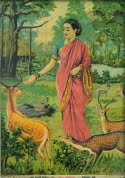
Sita and the Golden Deer: Wiki Commons 

Author's Note: This story is based off  the episode of Ravana and Maricha from the Public Domain Ramayana. I chose this style of writing because it highlights the tactical deception called upon by Ravana. Just as the Greeks did in the Trojan War, Ravana constructed a thing of beauty to help expose his enemy. In this case, Ravana would be the Greeks while Rama represents the Trojans. More specifically, Rama's love for Sita represents the gates of Troy, which will leave Rama crushed once this is breached. There is a lot of detailed dialogue that takes place between Ravana and Maricha in these stories so I borrowed this as an easy way to explain the relationship of this story to the Trojan Horse. I chose this topic because the deception of the Trojan Horse is something that the majority of people are familiar with. In this way, it becomes easier for people who are not familiar with the Ramayana to understand the workings of Ravana and his conniving, deceitful ways. While the Greeks are usually glorified for their use of the Trojan Horse, this provides a example of how it can inspire the workings of a villain like Ravana. This was something that caught my attention early on. Ravana used Rama’s strongest aspect, his love for Sita, as a way to bring him down. There is a lot of irony in the situation and I think the Trojan Horse was a good parallel to help point that out.
  

Bibliography:  Public Domain Edition of Ramanaya Myths of the Hindu Buddhists by Sister Nivedita (1914) Ravana and Maricha