Wednesday, September 30, 2015

Storytelling Week 6: Mahabharata Draft Day

Good evening, folks, and welcome to ESPN. We’re a bunch of guys wearing makeup talking about sports.

I’m Skip Bayles, and we have a very interesting show for you tonight. As we all know, this year’s draft just came to a close. As always, it was full of surprises. With Tebow returning to the Denver Broncos, Ray Lewis returning for a victory lap with the Baltimore Ravens, and the “out-of-left-field” drafting of OU’s Baker Mayfield to the Houston Texans, there is a lot to talk about.


BUT...what really has everybody buzzing is the shocking pickup of Shri Krishna by Arjuna of the Pandavas.

Recently returning from a 12-month suspension for foul play, the Pandavas were looking to bounce back with force. With this resurgence, everyone had figured that they would make a beeline for Krishna. But they weren’t the only ones who had their eye on the prize.

Duryodhana of the Kauravas pursued Krishna with the same tenacity. The rivalry between the Kauravas and the Pandavas goes back for decades and can arguably be considered the most heated rivalry in the world of sports. However, that is not the end to our story here. If you recall, it was the Kauravas who were responsible for the 12-month suspension of the Pandavas. So, folks, as you can see, there is a lot on the line here.

Now, Arjuna had always had Krishna on his radar. Since he was a young'un, Arjuna had always admired and respected Krishna above any other player in the game. In his eyes, victory was inherent with the help of Krishna. Facing the Kauravas in their first game back from suspension, Arjuna hastened to Krishna in preparation for war. Little did he know, Duryodhana had beaten him to the chase.

Surprisingly enough, this didn’t affect Krishna’s decision. The constant nagging and pompous attitude of Duryodhana rubbed Krishna the wrong way. For this reason, he gave Arjuna the first pick.

The choice was simple-Krishna or an entire roster of players. BUT, to spice things up even more, Krishna had announced to the men that he would retire from play. Now, with any rational thought one can basically rule out Krishna as useless. However, Arjuna’s lifelong devotion to Krishna held true and he chose him without a second thought. Even Krishna was surprised.

Durydohana, like the rest of us, basically took Krishna out of the picture once he learned that he would not suit up. So he was elated when he was essentially handed a full roster of fresh players eager to prove themselves.

After the deals were done and the papers were signed, Krishna and Arjuna met to talk things over. Luckily, Arjuna somehow managed to convince Krishna that he would be useful as an offensive coordinator. If he couldn’t play, he could at least help guide Arjuna through the game. Now, this folks, could turn out to be a huge game-changer. Krishna’s wisdom and presence is unmatched by any.

We spoke with Arjuna this afternoon about the whole ordeal and asked why in the world he was so optimistic about his new draft pick and he simply replied, “If you were going into the Super Bowl, would you rather have Tom Brady or the entire Fighting Tigers Pee Wee Team ?”

File:First Take Salute the Troops broadcast.jpg
Skip Bayles on ESPN's First Take: Wiki Commons


Author’s Note. This story is based on the episode Krishna and His Army, found in the Public Domain Edition Mahabharata. In this episode, the Pandavas have just been freed from their twelve year exile and are preparing for the inevitable battle with the Kausavas. As it has been demonstrated through various points in the epic, Arjuna has an immense adoration for Krishna and so seeks his help for the pending battle. However, Durydohana has the same thoughts so he seeks his help too. Ultimately, Arjuna makes the shocking decision to take Krishna over an army of one hundred million soldiers. This is even more shocking because Krishna declares he will not fight in the battle himself. So, both Durydohana and Arjuna go home from the deal content with their pickings. However, as the story develops you begin to see how Arjuna made the right decision. I chose this story because I think it demonstrates that it is not the size of the dog in the fight, but the size of the fight in the dog. I thought of the idea for the ESPN adaptation after reading Heather’s story written as a TV show review. I thought it was a cool twist so I tried to imitate that a little bit.

Bibliography. The Mahabharata, A Summary by John Mandeville Macfie (1921)

Thursday, September 24, 2015

Reading Diary B: PDE Mahabharata


  • Pandavas go undergo an exile similar to Rama's
  • Bhima and Draupadi unleash their angers on the eldest brother, but he remains faithful to his exile and to the will of the gods.
  • Arjuna goes off to gain celestial weapons that will come in handy later. 
  • Bhima encounters Hanuman in exile
  • Duryodhana and Karna go to spy on the Pandavas and are stopped by celestial spirits who would not allow it. A war followed, and the Kausavas were defeated. 
    • Karna deserted
    • Duryodhana and much of his court was captured
  • Bhima and Arjuna fight and get the prisoners released? 
    • humbled/embarrassed Duryodhana
  • Karna vows to kill Arjuna
    • A secret messenger comes and tells the Pandavas of this news
  • Indra, Arjuna's father, takes away Karna armour and earrings in exchange for a celestial dart.
  • The Pandavas come to a lake and all but Yudhishthira die from drinking after ignoring questions asked by a voice. It turns out the voice is Dharma, god of wisdom and justice. He grants Yudhishthira two wishes-That they should be restored to life and go unrecognized for a year. (their last year of exile is to be in hiding and they have to do another 12 years of Kausavas find them)
    • They return to INSIDE THE CITY and take up various roles
      • Yudhishthira-teaches playing dice (so he can practice)
      • Bhima-cook
      • Arjuna-teaches dance
    • All became loved by the monarch 
  • Bhima secretly kills King Kichaka for attempting to rap Draupadi. This causes the Kausavas to raid his kingdom. The raid conveniently falls on the last day of the exile, so the Pandavas turn on the Kausavas and were taken as prisoners of Kichaka's son
  • Both Duryodhana and Arjuna go to Krishna, but Krishna gets first pick because he was humbly bowing while Duryodhana pompously sat on his bed. Arjuna choses Krishna over an entire army. 
  • Duryodhana tries to capture Krishna, but it only angers Krishna and he takes his godly form 
  • The battle seems equal sided, but it is clear who will win. 
Bhima fighting with Bakasura color.jpg
Bima fights Bakasura: Wiki Commons

Reading Diary A: PDE Mahabharata


  • Prince Duryodhana planned to burn down a palace where the Pandavas and Kunti were staying. The palace was all wood and covered in oil. 
  • Vidura 
    • King Pandu and King Dhritarashtra brother
    • Wisest of the brothers, his mother was slave so he had no power
  • Vidura notices the signs of the plot and orders a tunnel to be dug to save his family. While they escape, a peasant family there begging for food dies and everyone thinks they it is the royal family. Dhritarashtra and Duryodhana think their plan has succeeded. 
  • In the woods the Pandavas come across some rakshasas. The sister tries to save them, but Bhima is noble and wont leave his family's side. He fights the bad rakshasa, even drags him into the forest so he wont wake up his family. 
  • Bhima and the sister of the bad rakshasa actually falls in love with Bhima and they live a happy life together
    • Give birth to a son-Ghatotkacha
  • The Pandavas and Kunti find refuge in a town that is ruled by Baka, who eats people in return for protecting the city. Kunti hails Bhima and he comes and kills Baka.
  • Drapuda, friend who betrayed Drona (guru who trained Pandavas)
    • His payment for training them was avenging Drapuda
  • Nalayani, daughter of Drapuda, was married to all 5 Pandavas 
    • This was the result of Karma for her actions in her previous life
  • Arjuna breaks a deal of the marriage of the Panadavas to Draupadi. While his brother tells him to let it slide, he remains truthful to his oath and exiles for 12 years. During his ecile he meets Ulupi, daughter of the nagas King, the same character who gave Bhima his powers. Here he gains the power to become invisible in water and has a son, Iravat. He then uses this power to rescue 5 water nymphs who were cursed to take the form of alligators 
    • good Karma 
  • The Pandavas burn a forest and it return a god Maya builds them a palace unmatched by anything on earth. As they become more powerful, Duryodhana becomes even more bitter. 
  • Yudhishthira loses all of the riches and lands of the Pandavas, including their wife Draupdi, who becomes a slave
    • This results in a ferocious proclamation of revenge by Bhima. 
  • The Pandavas are exiled after losing another gambling match
Vysa tell Drapuda about Draupadi's past life: PDE Mahabharata

Wednesday, September 23, 2015

Week 5 Review

I know I might be a little early, but there is already a lot of stuff I like about the Daily Announcements for this week. First, is this just because it's funny


I also am glad I saw the "You really can call me Laura!" announcement. Sometime professors are weird about what you call them, so it is nice to be able to be on a first name basis. It gives the class a relaxed feel to it. 

Reading Feedback

Week 5.
This week I chose the Public Domain Edition Mahabharata. I really liked this option because it allows me to work on the readings from anywhere. I have a busy schedule so it is very difficult to find time to go to Bizzel to accomplish the readings. I also like this because it gives you a nice reading guide that provides a little summary of each episode and gives little hints like "he will be one of the most important characters of this epic". My favorite part of the readings was the Bhima and the nagas section where Bhima's cousins attempt to murder him but it ironically ends up making up more powerful. I was a little confused on why Vysa did not immediately become king after his father had made that part of the deal for allowing King Pandu to marry Kunti. It took me a little over an hour to complete these readings. For the Reading Diary, I use a bullet format because I find this the easiest way to jot down pieces of information that don't necessarily flow completely.
Bhima fighting Duryodhana.jpg
Bhima fights Duryodhana: Wiki Commons


Week 6.
I chose the Public Domain Edition Mahabharata again for this week. I just love these online editions because they are so flexible and come with awesome Reading Guides. I love skimming over the reading guide and getting the broad over view into the story. Sometimes the stories can be confusing, so if you go back and read the reading guide you get the bigger picture and it connects the dots for you. Another awesome aspect of the PDEs are the links they include on certain characters, places, or things that are important to the story. I have never been familiar with Indian Epics prior to this class, so by clicking on these links you can go to a website that gives you the scoop on the who/why/what on whatever you are researching. I am a huge fan of these PDEs.
"That was easy" : Wiki Commons

Week 10 
This week I chose to read the online version of "The Life of Buddha" by Andre Ferdinand Herold from the Sacred Texts website. I chose this because I have always been intrigued by the story of Buddha. I have read a little into Buddhism, but had never learned anything about the background story. This provided a perfect way for me to learn about it. The readings are concise, but not too long, and made for an easy read. However, I do miss the reading guides form the PDE Mahabharata. I think adding Reading Guides for this would further solidify the understanding of the story. Overall, I really like this option. I think it is nice to have some options to chose from like this. 

The Death of Buddha, Japanese print, 17th century, detail (public domain image);
The Death of Buddha: Sacred Texts

Week 12. 
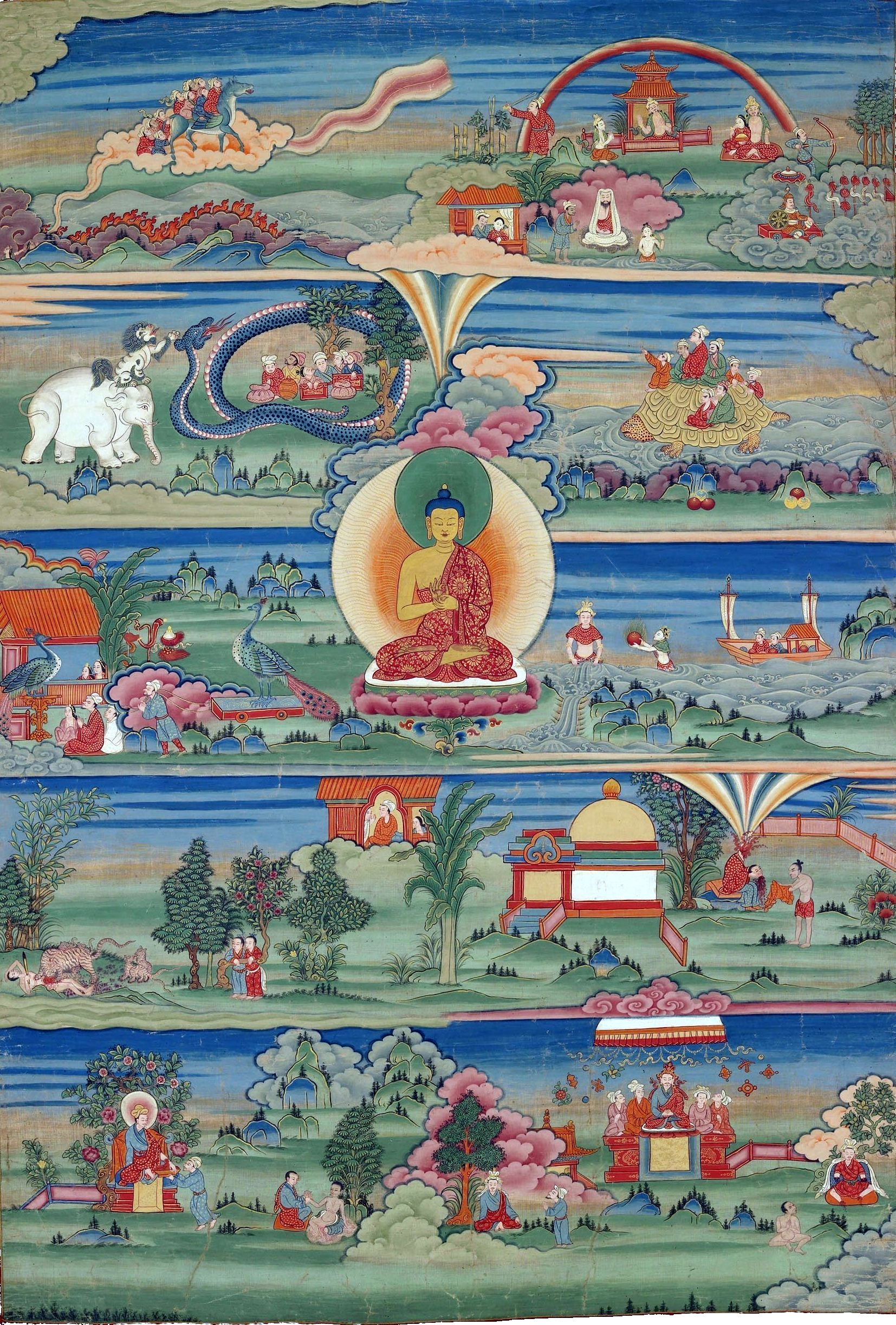
This week I chose to read the Twenty Jataka Tales by Noor Inayat. I absolutely loved these stories. This was recommended to me by Professor Gibbs after my week 10 reading on The Life of Buddha. I always love when animals are used to place of people, it gives the story a more playful atmosphere and almost makes it easier to understand that when you're reading about the complexity of people. I really liked this because it was super easy to access with its online site and it was also very easy to navigate. The link takes you to PDF of a book, so it feels like you are reading out of a Kindle or something. I am very glad I chose to read these stories. 

Bhutanese painted thangka of the Jatakas: Google Images 

Thoughts About Comments

Storytelling Comments. I think probably the most reassuring comments I read about my stories were that they were easy to follow. Sometimes I get the feeling that while the story makes sense in my own head, other people may find it confusing. As sort of an extension of that, I think it is helpful when people point out the main points/morals of the story. If I am writing a story that is easy to follow and that clearly delivers the message I am wanting to convey, I have reached the ultimate goal. Also, giving specific critiques help me improve my writings. For example, someone commented on one of my stories and said I could be a little more specific and then provided an example in "like naming the characters".

Introduction/Other Comments. I think it is interesting to read about how my introduction or other posts relate to other students. Since this is an online class it is hard to get to students, I think these type of comments make it easier to feel like you are getting to you your fellow classmates.

My comments. I think that I have room to improve my comments on Storytelling posts. After reading other peoples' comments I realized that I could probably afford to be more specific. I feel like my comments right now may me too generalized and not really help the author at all. By pointing out the clarity, main points, and specific critiques, I could leave some comments that may be of use to the author.

Storytelling Week 5: Pandavas v. Kauravas

One day Duryodhana and his brother's were playing in the garden when they noticed a group of people approaching the gates. At first this startled them. Once they group got closer, they realized that it was their aunt, Kunti, and their cousins, the Pandavas. This was a merry sight! It had been many years since the cousins had seen each other. They quickly began to chase each other around the palace grounds, laughing and enjoying this reunion. All but one. Duryodhana.

Since his birth, Duryodhana had been a trouble maker. Always picking on his brother, crying, and demanding attention at all times. The arrival of his cousins only appeared to him as an obstacle to overcome that chastened even his smallest of desires. He could not wait for them to leave.

However, Kunti had brought with her news that would change Duryodhana’s life forever. It had come to pass that his uncle, King Pandu had died. However, this news did not saddened the cold heart of Durydhana. What angered him was the news that his cousins would be staying, forever. King Dhritarashtra had agreed to accept the Pandavas as his sons, raising them along side the Kausavas as equals. This Durydhana could not accept. How could his father betray his sons in such a way?

As time went on, the Pandavas developed into mighty, valiant young men. Of all the Pandava brothers, Bhima was the most powerful. His presence in the royal city constantly overshadowed the Kausavas, the “natives”. Again, none was more distraught of this development than Durydhana. Now considered the leader of the Kausavas, his hatred for Bhima had grown deep and bitter.

Under the guidance of Durydhana, the Kausavas began plotting their destruction of Bhima. They thought, without their mightiest brother, the Kausavas would soon surpass the Pandavas in glory and triumph.

Finally the day came when the saga of Bhima and the Pandavas was to be put to an end. One day, while the brothers were enjoying a feast on banks of the mighty Ganges, Durydhana poisoned the food Bhima. Shortly after, Bhima dropped dead. Or so it appeared. Durydhana hastily dumped Bhima’s body in the river, ridding his side of this thorn.

Bhima sank into the river and was attacked by a swarm of angry serpants, called nagas. However, ironically enough, the serpents’ venom counteracted the poison he had been fed by Durydhana and he sprang back to life. But it was to late. Once he reoriented himself, Bhima was in the underworld city of the snakes.

Luckily for him, Aryaka, the great-grandsire of his mother, Kunti, inhabited this evil place. In place of certain death, Bhima was bestowed the power of one thousand nagas. After a period of respite, Bhima feasted in the city of snakes and returned to Kunti and his brothers. Telling his brothers the tall of his journey into the underworld, the Pandavas agreed to secrecy, never revealing to the Kauravas what had happened. 

File:Child bhima fight with Nagas.jpg
Bhima and the nagas: Wiki Commons


Author’s note. This story is primarily based on episode thirteen of the Public Domain Edition Mahabharata, “Bhima and the Nagas”. This episode essentially describes the climax of the tension between the cousins where Durydhana attempts to kill Bhima. I chose this story because of the irony of the situation. Durydhana has been an evil-spirited character since his birth and its bad omens. This makes him the ideal character to carry out an act like this. However, the irony come in because while he tried to get rid of him all together, his actions actually make Bhima more powerful, completely undermining the goals of Durydhana. He sort of “shoots himself in the foot”. I tried to make the episode a little more “story” like by beginning the story with the cousins in their youth. This shows their innocence at the beginning that turns to bitterness as they age. This also highlights the inherent evil of Durydhana. One message that I wanted to take away from this story is that sometimes the good guys win and what doesn’t kill you makes you stronger.

Bibliography: The Mahabharata, A Summary by John Mandeville Macfie (1921)